Note: This essay emerges from my lived experience and the witnessing of parallel lives within the Yemeni community. It is not an attempt to define a singular reality, but to name patterns, tensions, and truths that are often felt, lived, and left unspoken.
I expect some disagreement and the desire to silence what is uncomfortable. I hope we can push through the urge to quiet ourselves and each other for the sake of respectability politics.
Simultaneously, I know this will resonate with many, and further, I hope my words inspire nuanced conversations that will mobilize meaningful change for our beloved girls and women and nonbinary individuals.
We deserve better and have so much to offer the world.
“The battles over women’s bodies can be won only by a revolution of the mind.”
– Nawal El Saadawi
Becoming Seen
Girlhood, for me, was not just a phase of innocence, but an early training in visibility, discipline, and expectation.
I remember the first time taking off my hijab at the tender age of seven. It was the beginning of the school year, the end of summer, August sun shining bright, and yet I felt stifled in its heat. I was a young girl wanting to run around the playground with the kind of freedom only a child can embrace before she is taught to question it.
I would tuck it into my locker and put it back on before going home, returning with my hijab a little disheveled. Eventually, my mother pushed back my hijabi deadline and I enjoyed two more years without it.
By age nine, I was expected to put the hijab back on to fit in with the other Yemeni girls my age, a decision I followed more out of instinct than understanding. I didn’t yet grasp the weight it carried, only that belonging required it.
I grew up in the sheltered Yemeni diaspora community of Dearborn, Michigan, a culturally rich place where social conservatism did not just shape values, but constrained what futures felt accessible to girls like me.
To imagine a life outside those boundaries was to invite pushback, uncertainty, and the weight of being seen as deviant. But it was also a lesson and self- appreciation of my capacity to resist definition.
I grew to love myself even more through this complicated journey.
What Will People Say?
As a young Yemeniya, I learned how to seek approval from others. External validation, often expressed as “Aysh ya qoolo al-nas?,” or “What will people say?,” became a kind of ever-present authority, shaping my appearance, demeanor, speech, dreams, goals, temperament and preferences.
These “nas” (people) pre-determined so much of who I thought I should be, and even now, I find myself questioning which parts of me are still reaching for that approval and which parts feel like my own. More honestly, I am still learning how to sit with the tension between those internal and external forces, and to accept that all of it has shaped me into who I am today.
I grew to hate the color pink and cooking and long skirts. I detested soft spoken diplomacy and how girls are taught to lower their voices because the mere sight of a girl or woman and her voice is considered by some as 3awra (religious immodesty). I was at war with femininity for many years because of the ways I felt boxed into its seemingly passive personhood.
It took me a long time to reclaim these things and see the well-rounded beauty of being hard and gentle, girly and masculine, loud and quiet.
The Quiet Paradox of Girlhood
In my experience, being a Yemeniya meant growing up inside a kind of quiet paradox, one so normalized I rarely had the language to name it. For me, it meant being seen as precious and delicate, a keeper of purity in both mind and body. I felt, at times, like I was meant to remain a kind of permanent girl, sequestered in a way that kept me from fully stepping into the messy, necessary experiences that shape a whole self.
As a girl, I felt both overtly sexualized and diminishingly asexual: a body that is punitively monitored to eradicate unbecoming displays of tantalization for the male gaze and at the same time also treated as an untouchable, androgynous holy figure.
Reputation Over Self
I learned to carry myself as something that must not be dropped and broken, something that must be handled with burdened care, something whose value lies in remaining uncracked.
But living this way long enough, I began to see that it is not my inner life that is being handled gently. It is not my questions, my contradictions, or my ambitions. It is not how I learn to build character, how I treat others, how I care for myself and the people around me, how I move with integrity or defend myself against what harms me.
It is my reputation, a carefully controlled optical illusion as defined by male-centric social decorum, that is being prioritized above all else. Reputation, in this Arab cultural context, is weighted under the de facto law of 3ayb (shame/disgrace/fault/social taboo) and sharaf (honor inextricably tied to that of others’ in a communal family system) and socially determines what is and is not acceptable in order to belong.
It is the reductive idea of what a “good Yemeniya” should be.
And that idea must remain intact, otherwise the illusion of a “perfect family and tribe” begins to shatter. In an honor-driven society, that can be a dangerous thing.
From a young age, I understood that being seen could carry consequences. A mundane conversation with a boy in a parking lot could travel through three households by sunset. A simple smile could be misread and insidiously labeled. A generic photo of yourself on the internet could sully your family’s name. An ugly rumor could destroy lives.
I began to measure my laughter. I calculated how late I stayed outside the home and who would see me. I learned who reports back to who. I always felt both exposed and ignored in the world.
When you can’t faithfully turn to family, and are instead met with exasperated refusal and told, “why can’t you be like other girls?”, you learn that a secret life is thrust upon you to survive.
And gossip is never just gossip, especially in culturally conservative communities. It is not harmless chatter. It is a tool of control. It disciplines without needing formal rules. It punishes without needing evidence. It shapes behavior through the fear of social exile, or even physical and emotional harm.
For many years, I was terrified to be seen. Even now, as I write this with the explicit intention of being seen, a younger version of me still feels nervous about being misunderstood.
The terror of doing the “wrong thing” still crosses my mind, my words and actions being used as a cautionary tale to restrict another Yemeniya, as many who have been martyred in dishonor before me. Growing up, I would hear stories of the “bad girls” and the way they were punished. I was told to be careful stepping out of line otherwise I would end up like them.
I invisibilized myself so thoroughly that it began to alter how I carried my body. My voice shook and weakened beyond recognition, even as my confidence strove to grow and come alive. I edited and reduced myself over and over again in anticipation of critique that was always there, lurking and seeping into the inner sanctum of my mind. I felt an overwhelming imposter syndrome, never quite sure how to understand and accept myself when everything around me says I shouldn’t.
I thought that if I learned to disguise myself under the watchful gaze of the community, I would be safe.
Instead, I began to hate myself.
I stopped recognizing myself. I struggled with anxiety in my body and breath for decades. I second guessed everything. I only knew how to hide and pretend as mechanisms of safety. I would vet other Yemenis to make sure they were open minded. I stayed away from Yemeni gatherings and shied away from the people and culture that is always a part of me.
I harmed myself in the negligible ways we do to be accepted.
There is something violent and corrosive about constantly muting who you are. It does not just limit your life.
It callously erodes your sense of worth.
I reached a point where something had to give, or I would not survive myself. The mounting internal pressure of knowing and accepting myself became louder than the conditioned panic of communal gossip and the weight of retribution.
The invisible hand of psychological and literal surveillance still follows me. It was heavier in my younger years, before I learned, slowly, that I could hold myself through and outside this system of conformity and control.
I decidedly began to understand, as Alice Walker once wrote, that the most common way we give up our power is by believing we never had it to begin with. So much of mine had been conceded before I even realized it was mine to keep.
The world is big and complicated, and the truth of who I am is a power that can only be taken if I agree to give it away.
And it is from that intimacy, from that deep sense of inalienable selfhood, that I feel compelled to speak about the ways we diminish our girls and women into deadened symbols of virtue and strict gender roles.
What We Don’t Say Out Loud
I also know that the story I am telling is not every story. There are Yemeniyat who feel supported, who wear their hijab with intention and conviction, who are loved in ways that allow them to move through life freely. That is beautiful and also true. I respect and agree that a range of experience does exist.
But this is my experience, and it undoubtedly echoes the experiences of many others. Naming it does not reduce us to a single story, nor is it my responsibility to soften the truth to protect against stereotypes of the “oppressed Arab woman.” We cannot grow if we refuse to face what harms us.
I am writing this for the Yemeniyat who need to feel seen in all the ways I needed and still do.
I have seen and lived how اﻟﻧظﺎم اﻷﺑوي (Al-Nidham Al-Abawee), the patriarchal order we are raised within, has been wielded to keep girls small, afraid, and uncertain of their own potential. How God has been used, unmoored from the expansive divine itself, to justify naseeb (fate) for a life meticulously outlined for us. I have seen how easily curiosity is stifled, how education is deprioritized, how ambition is framed as danger. I have personally known the threat of being sent “back home,” married off to preserve reputation, to save face, to restore a sense of control.
And I am not alone.
I have seen, and felt, how girls and women in our community are dismissed for wanting more, and how some are met with consequences far worse, including excommunication and violence and abuse and death, for stepping outside what has already been decided for them.
And I understand, too, that so often this comes from parents and ancestors whose own possibilities were once narrowed, whose own lives were shaped by the same rigid rhetoric and protocol for the sake of social order.
In many cases, they are passing down what they were taught would lead to stability, respect, and a good life. It is often well-intended. It is often all they know. And still, intention does not erase the harmful impact it can cause.
The Anti-Map
I speak for the girl I once was, who was never meant to be anything more than a dutiful wife and a sacrificial mother. I was never supposed to be where I am now. It was not just that I lacked a roadmap for an unconventional life. I was given an anti-map, a set of warnings, a blueprint of what not to become.
I was taught to fear becoming the “wild, Americanized bint Amreeka,” a devilish pariah, a figure used to discipline and distance other girls, someone imagined as living outside of moral bounds, reduced to caricatures of being reckless, godless, or lost. And in that fear, so many of us learned to suppress the very parts of ourselves that might have led us toward fuller, more honest lives.
I grew tired of this fear and how it’s used to emotionally blackmail girls and women that are always more complicated than the good vs. evil trope that arbitrarily decides who is worthy of love.
I grew maddeningly irritable at how this keeps us othered and divided.
Breaking the Script
When I was a teenager, the script felt narrow and predictable. Marriage soon after high school. A respectable timeline for a respectable girl. When I did not want to follow that order, it was not framed as a difference in preference. It was framed as a defect. Something must be wrong with me. I was told I would only get older and unwanted, that I would “expire” out of fashion, left with scraps, a burden to my family.
When I pushed to get my driver’s license, it was seen as conditional independence. In college, when I asked for a phone, I was first given a flip phone with limited minutes because smart phones had “too many wayward options.” When I insisted on going to college, it was an ambition that was met with constant roadblocks and mandates, rules and justifications.
I was never taught how to be self-sufficient, only dependent.
Becoming a Spectacle
And years later, when I made the independent, thoughtful, years-long decision to take off my hijab entirely, that choice was not impulsive or reactionary. It was slow. It was private before it was visible. I questioned myself. I prayed. I wrestled with what was cultural and what was spiritual. I asked whether I was moving toward myself or simply away from pressure.
I sat with that decision for a long time before anyone else had to.
This was not, for me, a rejection of the hijab itself, nor a declaration that freedom requires its removal. I have deep respect for women who wear it with intention, conviction, and love. What I am speaking to is something more fundamental: the right to arrive at our choices through informed, uncoerced will, rather than obligation, fear, or social consequence.
It still became a spectacle.
People spoke as if I had discarded faith itself. As if a piece of cloth was the sole proof of my morality. As if my ethics, my discipline, my internal life could be reduced to what rested on my head.
The conversation was never about my process. It was about how I was seen and observed.
The Body as Public Property
And that is what so many Yemeniyat, and womankind still, learn early. That our bodies are treated as communal property, always open for discussion. That our choices are understood as public announcements. That even when a decision is made carefully, thoughtfully, over years of reflection, it can be flattened within seconds into assumptions of superficiality and the virgin-whore complex once others catch wind of it.
It is difficult to explain to outsiders the deeply intimate, psychosocial impact of how something as simple as fabric can feel like an extension of your own skin. The first time I walked outside without the hijab I had worn for two decades, I felt both exposed and electrified. I remember scanning faces. I remember bracing for impact.
And then, after a time, I remember realizing how absurd it all felt.
The Moment Everything Shifted
I remember the moment clearly. After another anxiety attack, with tears staining my face and my hands shaking, I said out loud, “Fuck it. I cannot keep hurting myself to appease people who will never be satisfied anyway. It will never stop.”
And it didn’t click right away. Nothing changed overnight. But I found myself returning to that thought over and over, sometimes with relief, other times with fear. Still, I couldn’t shake the truth of it.
As far as any of us know, this is our one life to live. My one life. And I didn’t want to regret not at least trying to live it my way, staying open to learning as I go.
I know who I am. I know the values I carry and do my best to live by them. I know my purpose is to help others own their stories, their dreams, and their talents.
I couldn’t fully do so without braving to stand by my own.
Choosing to Stay
Years ago, when my questions became louder than my fear, I went looking for language. I sought mentors. I devoured books by women who had named constraints before I could. I read texts by Arab women that resonated. But I did not agree with all I read and what it demanded. Some preached that leaving the community was the only answer. And for some who face violence or the threat of violence, that may be the only way they see out and we cannot discount their agency to choose how to find peace and belonging.
I took inventory of my situation, and although faced with my own challenges, could not accept that the only path to freedom was departure, or that leaving the community was the price of becoming whole.
I did not want exile to be my empowerment story.
I found myself more deeply reflected in writers for women who choose to stay, to negotiate, to transform their lives from within. That felt closer to the truth of what I was trying to build.
I wanted to stay. So I stayed.
Living With Consequence
The decision to stay was not romantic. It was stubborn. I was born here and built my life here in small and big ways. This community is where I crawled and walked and fell and got up again.
Here is where I learned to read and write, and grew a passion into a career. Here is where my skin toughened and softened to other human beings.
I have lost personal relationships I thought were permanent and gained others that surprised me. I have been ridiculed and defended. I have been shunned and quietly admired. I have been called shameful and inspiring, sometimes by people who share my bloodline.
There are family members who no longer speak to me and those I am still lovingly close with. There have been hateful messages from family and strangers alike meant to make me feel small and afraid. On my worst days, I let them get to me. On the better days, which have become more frequent, I roll my eyes at the section of our community that preaches ugly, misogynistic tribalism and its pathetic attempts to stop a grown woman from doing the one thing we all want: to live a peaceful, fully actualized life.
I have been bullied to change my last name, my family name. I wholeheartedly refuse to bend. As if my lineage could ever be taken from me or renounced.
I will not erase myself.
We Are Not Alone
Much like I was hungry to find community and understanding in my own journey, other women have felt the same. Over the years, Yemeni friends and strangers (men and women) have reached out privately, their messages sometimes careful and a little hesitant, asking how I dealt with the gossip, how I handled the isolation that comes from stepping outside a narrow frame, how I stopped believing that something was wrong with me. They asked for guidance on how to support themselves.
They’re not searching for anything incredulous. They just want to feel like they can live their lives without the fear that gripes us in its crippling despair.
We’ve Come Far, But Not That Far
We have come further along than we were when I was a teenager. More Yemeniyat are in classrooms. More are earning degrees. More are putting off marriage until they have fulfilled other goals or, in desperate times, choosing divorce to safeguard their wellbeing and safety and that of their children. More mothers and fathers and other family members are seeing the need to welcome the liveliness of self-expression. More are imagining timelines beyond one prescribed outcome.
That matters.
But education and movement for some does not undo all the conditioning that is still very much chokingly pervasive in many of our households. You can have a diploma and still feel monitored. You can have a career and still edit yourself at the office and family gatherings. You can be a mother with grown children and still be reprimanded like a child. You can be accomplished and still feel like your autonomy is up for approval.
We can be free in some ways but not in others.
Policing Each Other
And too often, we participate in policing each other. We tear each other down instead of making room for the range of talents and ways of being among us. We whisper about the girl who dresses differently. We question the one who waits to marry or chooses not to at all. We look away from, or quietly condemn, those whose queerness does not fit within what we have been taught to accept. We minimize the artist. We doubt the one who wants to do what’s never been done before.
We measure each other against narrow templates instead of recognizing the fullness of who we are.
I Am A Proud Yemeniya
And still, there is so very much I love about being a Yemeniya. I think of the scent of bakhoor (incense) burning sweetly through our homes, of childhood mornings and evenings filled with the voices of Abu Bakr Salem and Ayoub Tarish. I think of the colorful, floor-length and sparkling diroo3 and patterned thobes women wear around each other, moving excitedly through rooms that carry the ease of a space of our own.
I think about the musicality of our language, the natural rhythmic cadence of the Yemeni Arabic dialect. Open and quick at times of passionate conversation; how soft and liquid our voices are in close, affectionate settings.
I think of kitchens alive with the making of 3’seed, marak, saltah, and lamb haneeth. Homes fragrant with cumin, clarified butter and sundried onions, afternoons warmed with the heated spice of qahwah (coffee) and shahi (tea).
I think of the soft clink of a wrist full of my mother’s golden bangles, the quiet household chime of my younger life.I remember the old clock on the mantle in our living room, sounding out the poetic call of the adhan in echoing intervals, inviting stillness and prayer.
I think of the old and new photographs from back home and displays of small, nostalgic figurines of Shibam’s iconic skyline, Bab Al-Yemen, and Mahram Bilqis, pressed into decorated walls and our imagination.
My eyes tear up with thoughts of all the loving trappings of ancient culture we carry with us wherever we go and what it means to savor the touches of belonging in our past and present and future.
Remembering Queendom: See Me Seeing You
Our beloved Yemen is exalted in the lores of Queen Bilqis of Saba (Sheba), Queen Arwa al-Sulayhi and Queen Asma bint Shibab, in stories of women-led sovereignty woven into our history. We speak proudly of that lineage. But somewhere along the way, our collective memory dimmed. We forgot what it means to honor women not just as symbols of purity, but as doers, thinkers, builders, and leaders. We forgot the harm in silencing half of our population while depending on their labor behind the scenes, the work that holds everything together.
We come from Queendom, it is in our blood and spirit as a people.
We do not have to abandon tradition to remember that. Thriving can look like carrying tradition with intention. It can also look like blending in something new.
Living in Plain Sight
I love the sense of community we build with each other. I’ve seen Yemenis come together in powerful ways, guided by care and a strong sense of what is right. There is a humility in us that is deeply compassionate and grounded. We are tightly knit, sometimes insular. That closeness can feel like warmth, and sometimes, like being watched.
And that feeling of being scrutinized does not disappear. It stays with you. And I know I am still being watched.
Good.
Not because I want attention for vanity’s sake, but because I refuse to hide any longer. I refuse to disappear myself to make others comfortable.
If there are eyes on me, let them see me clearly.
Let them see me in joy and in struggle. Let them see me be human, ordinary, unremarkable. Let them see me blessed and living. Let them see that a Yemeni woman can exist publicly without threatening the seemingly fragile fabric of a longstanding civilization and community.
More importantly, I want the Yemeniyat who feel out of place to see someone living openly. To know there is nothing defective about them. There is nothing wrong with being visible, just as there is nothing wrong with choosing privacy. Nothing wrong with wanting a life that is their own.
We can exist in public.
There is nothing wrong with us.
Why I Speak
I am speaking now because I deeply love this community. I come from a hardworking family who came to this country to build something sustainable, something that could withstand instability and give their children options they never had. I grew up watching my parents’ blood, sweat and tears embodied in real time.
Social reputation was protection. It was survival, built in response to instability and the need to preserve safety, dignity, and belonging. I understand that fear.
But I also understand that we are strong enough to evolve.
The Revolution of the Mind
I understand now that this work begins in the mind. In an imperialized, capitalistic world that constantly tries to define us before we can define ourselves, in our local community where Yemenis are insatiably taking up long overdue space, thinking critically becomes an act of care and resistance. It is how we empower ourselves. It is how we empower each other.
To question, to choose, to live in alignment with what feels true, even when it is misunderstood, is its own kind of revolution.
I no longer believe I have to leave myself to find what is right. There is something sacred in listening inward, in trusting that what spiritually guides me is not separate from me.
As Tawakkol Karman reminds us, “I would like the world to know that Yemeni women are strong, and if empowered, they can achieve. The world needs to look beyond stereotypes and dress code. In our hearts, we are just human beings who want to live a dignified life. Is that too much to ask for?”
Who are we before we are defined?
I don’t know, and I think that’s where the magic lives.
Being undefined is where freedom begins. It is where imagination remains boundless, where you can be who you want to be, and who you come to find yourself to be, on the road to even a whisper of a vision you have for yourself.
It’s when we try to prematurely define ourselves and each other that we begin to lose that sense of possibility.
Who are you before you are defined?
Go forth curiously, and find out.
Rasha Almulaiki
October 2026
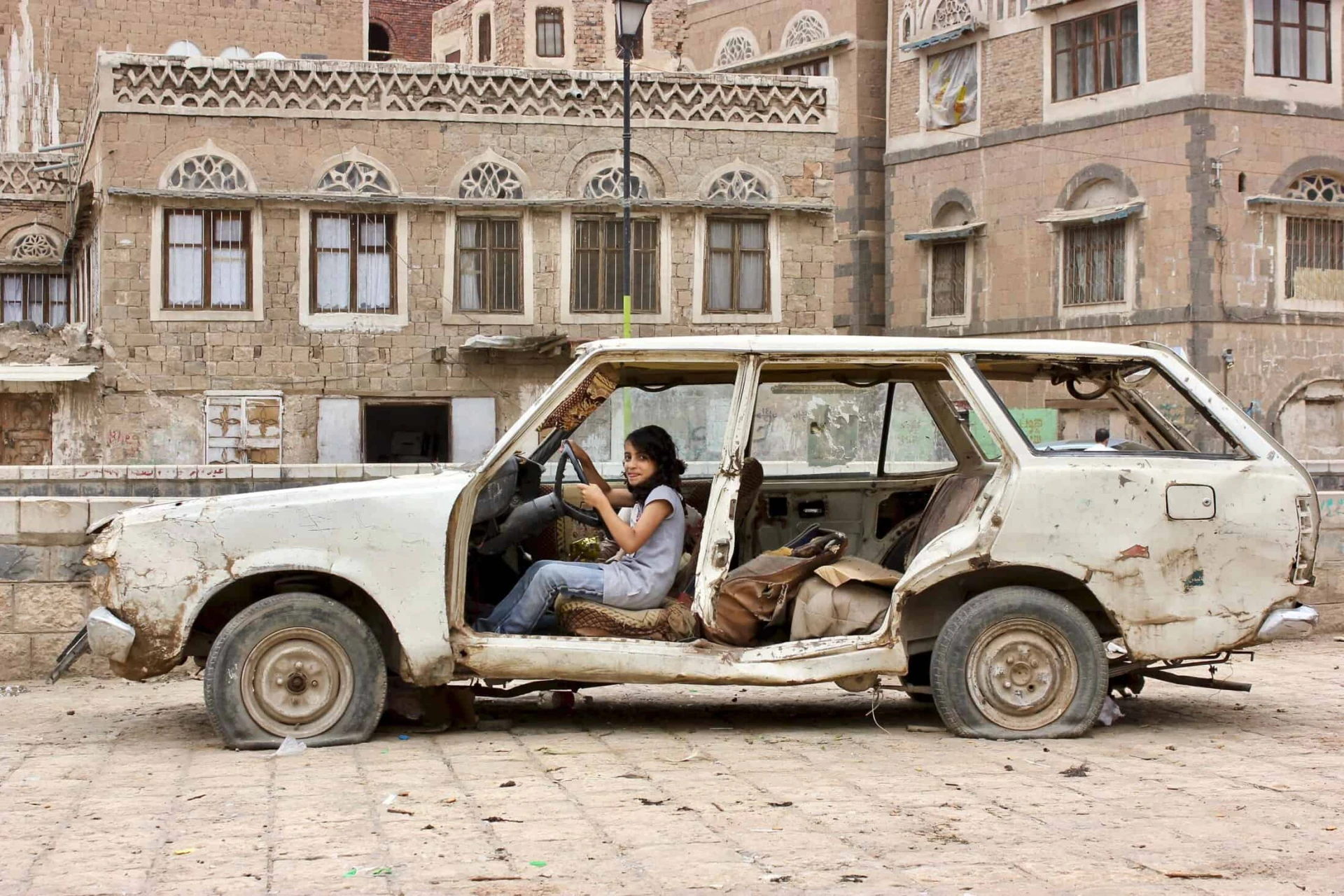
Featured Image: A Yemeni girl sitting in the driver seat of an abandoned car in Old Sana’a, posing for a photo. 2014. Photo by Jenna Z.
A beautifully written piece. The image of the anti map is powerful.